

AI ROI in Contact Centers: Why Strong Metrics Hide Real Problems
When dashboards turn green but agents burn out, your measurement model is optimizing for the wrong outcomes
Learn why traditional AI metrics like containment rate and cost per interaction mask declining agent and customer experience. This piece offers a framework for measuring AI ROI that weights human outcomes alongside operational efficiency.
- Efficiency metrics alone are misleading – When AI dashboards glow green but agent burnout rises and customer satisfaction stalls, the measurement model is the problem, not the technology.
- 56% of contact centers miss AI ROI targets – The majority fail because they measure machine output (cost, containment, handle time) without equally weighting human outcomes (agent experience, retention, customer effort).
- Adopt a dual-signal framework – Track operational efficiency and people outcomes side by side. Real AI ROI is the ratio between what the machine saved and what the humans gained.
- People-outcome data wins budgets – CX leaders who present AI as a workforce stability and customer loyalty tool (not just a cost play) have a structural advantage in every executive conversation.
The Dashboard Says Everything Is Fine. Your People Say Otherwise.
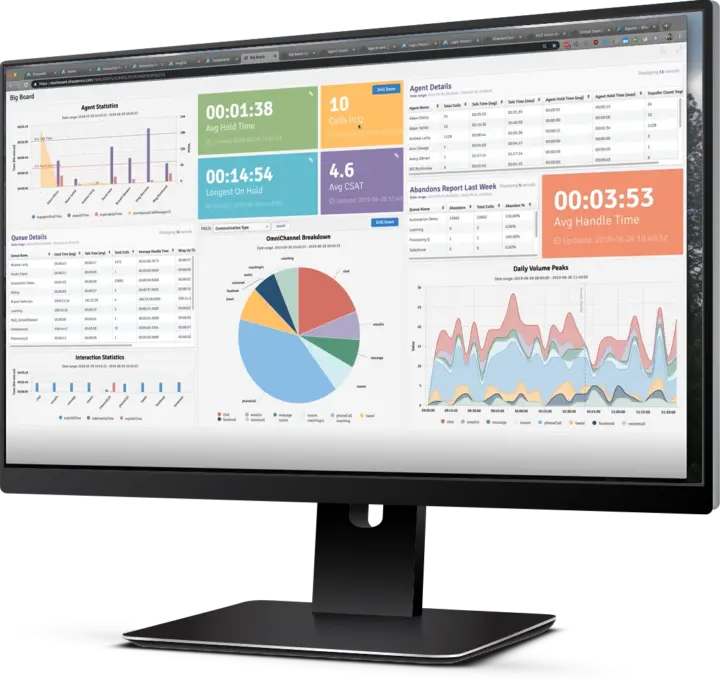
There’s a particular kind of dissonance that keeps CX leaders up at night. The AI metrics are trending green. Containment rates are climbing. Cost per interaction is dropping. And yet, agents are burning out faster than ever, customers are still escalating, and your NPS hasn’t budged. If you’ve felt that gap between what the data says and what your gut tells you, you’re not imagining things. The measurement model is lying to you, not because it’s broken, but because it was never built to tell the whole truth about AI ROI in contact centers.
How We Got Hooked on Efficiency Theater
It’s easy to see why cost-reduction became the default lens for measuring AI in customer service. The numbers are seductive. AI-handled voice interactions cost roughly $0.20 compared to $5.50 for human-only calls. Call deflection rates can reduce human agent workload by 40 to 60 percent. When you’re presenting to a CFO, those figures practically sell themselves.
So we built our dashboards around them. Average handle time. Automation containment rate. Cost per resolved interaction. And for a while, it felt like progress. The problem is that these metrics were designed to measure machine output, not human outcomes. They answer the question “Is the AI working?” but completely ignore the question “Is anyone better off?”
That distinction didn’t matter when AI was handling simple password resets. It matters enormously now that AI is reshaping how agents work, what customers expect, and whether your best people stay or leave.
The Real Problem Isn’t the Technology
Here’s what we actually believe: when AI metrics look strong but agent and customer sentiment don’t follow, the measurement model is the problem, not the technology. You don’t have an AI failure. You have a visibility failure. Your framework is optimized to see one dimension of performance while the dimensions that determine long-term success remain invisible.
AI ROI in Contact Centers Demands a People-Outcomes Lens
Consider what’s happening across the industry right now. Only 44% of contact centers report meeting their expected ROI from AI implementations, with the majority failing due to strategy and integration gaps. That’s a striking number. More than half of organizations invested in AI, watched the efficiency metrics improve, and still couldn’t call it a success.
Why? Because they measured the wrong things.
We’ve seen this pattern repeatedly: a contact center deploys AI-powered routing and agent assist tools. Handle times drop. The containment rate looks healthy. Leadership celebrates. But six months later, agent attrition spikes. Customer satisfaction scores flatline or dip. The “efficiency gains” evaporate because you’re spending them on recruiting, onboarding, and recovering from the institutional knowledge that walked out the door.
Now contrast that with organizations that weight their AI measurement differently. When agent assist tools are measured not just by speed but by their impact on first contact resolution (which increases roughly 14% with proper implementation) and agent burnout (which drops approximately 25% in AI-supported teams), the story changes. The AI isn’t just cheaper. It’s making people’s jobs better, which makes customers’ experiences better, which makes the business healthier.
This isn’t a soft argument. It’s a financial one. The cost of replacing a single contact center agent ranges from $10,000 to $20,000 when you factor in recruiting, training, and ramp time. If your AI measurement framework can’t see the connection between a real-time sentiment monitoring tool and a reduction in agent turnover, you’re flying blind on one of your largest controllable expenses.
Platforms like Sharpen were built around this exact principle: that agent experience and operational efficiency aren’t competing priorities but reinforcing ones. When your measurement framework treats the agent experience index as a first-class metric alongside cost per interaction, you start making fundamentally different decisions about how to deploy and tune your AI.
The data backs this up from the customer side too. Companies using AI in customer interactions saw customer satisfaction scores rise by 22.3%, but only when the implementation was designed around the full experience, not just deflection. The organizations that saw those gains weren’t the ones with the most AI. They were the ones that understood what their customer satisfaction metrics were actually measuring.
What Changes If We Get This Right
If this thesis holds (and we believe the evidence is overwhelming), then several things follow. First, every AI business case built purely on cost savings is incomplete and potentially misleading. You need agent retention data, customer effort scores, and sentiment trends sitting right next to your efficiency metrics, not in a separate report that nobody reads.
Second, the CX leaders who build internal buy-in using people-outcome data will have a structural advantage. When the next budget cycle arrives, they won’t be defending a cost center. They’ll be presenting a system that demonstrably reduces attrition, improves resolution quality, and lifts loyalty. That’s a fundamentally different conversation with the C-suite.
Third, the gap between customer service KPI categories that track operations and those that track human experience needs to collapse. They belong in the same dashboard, weighted equally, reviewed together.
A New Lens: The Dual-Signal Framework
Here’s the reframe we keep coming back to: AI ROI isn’t a number. It’s a ratio between what the machine saved and what the humans gained.
Think of it as a dual-signal framework. One signal tracks operational efficiency: cost per interaction, containment rate, handle time. The other tracks people outcomes: agent experience index, first contact resolution, customer effort score, retention and burnout indicators. When both signals trend positive together, you have real ROI. When only one does, you have a ticking clock.
This framework doesn’t require new technology. It requires new discipline. It means asking your AI vendor not just “What did the bot handle?” but “How did the agent feel about what was left?” It means treating happy employees as a leading indicator, not a nice-to-have.
The Measurement Model Is the Strategy
We don’t think the contact center industry has an AI problem. We think it has a measurement problem dressed up as an AI problem. The organizations that close the gap between CX data and action won’t be the ones with the most sophisticated AI. They’ll be the ones brave enough to measure what actually matters, even when the efficiency dashboard is already glowing green.
The question isn’t whether your AI is working. The question is: working for whom?
Frequently Asked Questions
Which metrics should be prioritized to assess the impact of AI on agent experience and retention?
Prioritize the agent experience index, burnout indicators, and first contact resolution alongside traditional efficiency metrics like cost per interaction. When agent-facing metrics improve in tandem with operational ones, you have a reliable signal that AI is delivering sustainable ROI rather than short-term savings.
Why do AI metrics sometimes look strong while customer satisfaction metrics stay flat?
Efficiency metrics like containment rate and handle time measure machine output, not human outcomes. If AI is deflecting volume but leaving agents with harder, more draining interactions (and customers with unresolved complexity), satisfaction won’t follow no matter how green the dashboard looks.
How can CX leaders build internal buy-in for AI investments using outcome data?
Pair cost-savings data with people-outcome evidence: agent retention improvements, burnout reduction percentages, and customer effort score trends. Presenting AI as a workforce stability tool, not just a cost-cutting tool, reframes the investment as a growth driver rather than a line-item reduction.
Sources
- https://aloware.com/blog/contact-center-ai-architecture-use-cases-and-roi
- https://www.copc.com/how-to-close-the-ai-roi-gap-why-56-of-contact-centers-are-failing-to-realize-value/
- https://sharpencx.com
- https://www.zoom.com/en/blog/chatbot-statistics/
- https://sharpencx.com/customer-service-kpi-categories-for-off-the-chart-cx/
- https://sharpencx.com/happy-employees-happy-customers/