


How Managing and Coaching to Agent Performance Metrics Amplifies Your Call Center’s ROI
Almost 80% of your agents show up to work without knowing what’s expected of them.
Many business leaders view the contact center as a cost center, so developing and investing in agent performance falls off the radar. The less money you spend in the contact center, and the more output your CS team delivers, the better your business outcomes, right?
I’m here to swoop in and give a big nope to that.
The false perception that more output automatically equals better outcomes keeps contact centers from reaching their full potential. This often occurs because many business leaders don’t see the contact center from the manager’s perspective.
[Download Now] Partner with your VP of Ops on these 7 projects to improve your call center ROI
Good managers know that the way to drive performance up and reduce costs isn’t about trimming budgets and piling more work on your call center agents. Instead, they focus on coaching agents to improve performance and achieve higher call center ROI.
Outstanding performance only happens when you set clear goals, give regular feedback, and keep your team informed of their progress. When your team doesn’t know what’s expected of them, or how they’re meeting (or missing) those expectations, you fail to reach team and company goals.
Today, we’re walking through how to fix stalled agent performance with four steps to invest in your team and amplify call center ROI. (Or your money back. Literally.)
1. Monitor and display agent performance metrics in real-time.
Choose three metrics that matter most to your business outcomes and monitor them daily with dashboards and Performance Tiles. Communicate openly with your agents about the KPIs they need to hone in on and use reporting tools to provide them with real-time visibility into their performance.
When choosing the metrics to help you amplify ROI in your call center, keep these criteria in mind:
- Choose metrics your systems can measure automatically. When you rely on people to input information in your systems, data can become inconsistent. Having automated call center metrics ensures accurate data and supports informed decision-making.
- Pinpoint metrics you can measure frequently. Sporadic reporting and once-a-month measurements won’t give you the intel you need to make clear decisions on how to improve agent performance. Choose metrics that can be tracked continuously and in real-time.
- Make sure your agents can personally influence each metric. Metrics like Service Level and First Contact Resolution are difficult for agents to influence. While they can adjust how fast they answer the phone or how well they help customers, they can’t change how many of their peers call in sick or how many times a customer reached out for help before phoning them. Instead of surfacing standard metrics like these to your team, single in on performance metrics that each agent can directly impact.
With real-time reporting, agents get a wealth of knowledge about their performance. They see how every interaction they handle impacts your core business outcomes and gain constant visibility into how they’re reaching team and individual goals (or falling short). These insights enable contact center agents to proactively tackle issues that may be hindering their performance.
2. Communicate the driving cause behind your performance standards and metrics.
It’s simple. We’re curious beings. When you ask your agents to make a change, their natural reaction is to ask “why?” Instead of leaving lingering doubts that drum up uncertainty, clarify the drivers behind each performance metric you choose.
Answer these questions clearly and concisely when rolling out new daily performance metrics for your team:
- What do you want agents to learn by looking at their daily metrics?
- Why is it important that they have visibility into these metrics and their progress?
- If agents aren’t meeting performance standards, what will you do to help?
- And, why is it crucial that agents consistently meet their KPIs?
3. Use the daily performance data you collect to strengthen 1:1 coaching.
Frequent coaching clarifies goals, expectations, and performance, helping agents understand where they can improve. And, they enjoy the process.
Management engagement plays a key role in achieving performance management success. When managers show up to performance conversations with tangible data to support their conversations, agents have a clear view of where to improve. And, when you bring relevant feedback and suggestions based on the data you surfaced, agents learn how to improve.
[Read Next] 4 example wallboards and dashboards that give you tangible data to coach your agents
What’s more? When managers have solid data to commend agents on a job well done, performance keeps climbing. A happy agent knows they’re doing well (and recognizes that others know it, too).
4. Earn back agent FTE hours and use them elsewhere.
To truly up-level agent performance and grow your call center ROI, the performance metrics you choose must have a quantifiable impact on your bottom line.
We like to quantify ROI in terms of agent hours, or if you’re looking for a dollar sign, your staff’s FTE costs.
Since metrics like Active Contact Resolution (ACR) and Average Handle Time (AHT) can be directly linked back to business costs – such as agent hours and cost per contact – these are easy metrics to kick off your performance management plan and help boost call center ROI. But what happens when you decrease FCR by 1%? What about AHT?
Here’s an example:
Let’s say your AHT for a phone call sits at five minutes. Average salary data puts the hourly rate of an agent at $17. So, your five-minute handle times put roughly a $1.40 price tag on every interaction. (In terms of agent hours alone – not factoring in the cost of your tools, supervisors, IT, and brick and mortar expenses.)
[Learn More] Schedule a demo with Sharpen
Now, think about how an incremental improvement to your AHT can reduce your agent hours (and the associated costs). Let’s say you have a team of 100 agents, who each handle 50 phone calls per day and work 250 days per year. Your five-minute handle times cost you roughly $1.75M in agent FTE costs per year. Reduce your AHT by only 5%, and you get back 6,000 agent hours and decrease FTE costs by $70,000.
The more your agents improve AHT, the less of their hourly rate you spend on each conversation, and the more time they have to dedicate to other areas of the business (or take a well-earned vacation).
So, how do we know that performance management skyrockets call center ROI?
We tested this performance management framework with a few of our customers.
Our friends at Sandia Area Federal Credit Union shared legacy data with us (and their team). Then, they put three key metrics on display for their agents – telling them when to pay attention to each.
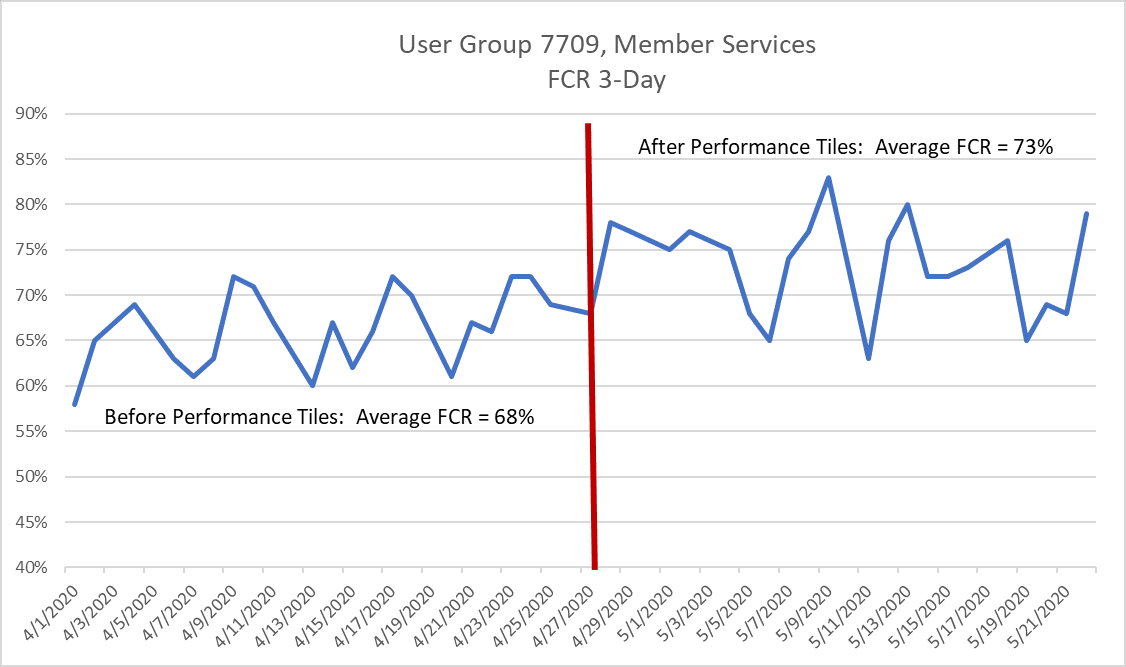
In a short 12-day window after showing agents their Active Contact Resolution, the contact center saw a collective 5% increase in resolutions (with fewer customer callbacks about repeat issues for the entire next month).
[Learn More] See how Sharpen Performance Tiles are built for better business outcomes
And now, ACR is up from 69% to an average in the high 70th percentile. Some days, they’ve reached above 90% ACR.
“Every single thing that gets data in front of our agents on a consistent basis, helps.”
— Matt Benidt, CXO, Sandia Area Federal Credit Union
Another customer of ours, Blackhawk, saw similar success. They moved agents home at the start of the pandemic and turned to Sharpen Performance Tiles to monitor and coach their team remotely. After surfacing daily metrics to their agents, Blackhawk realized more than an 8% improvement in handle times, reducing required agent hours by 5%.
[Download Now] Partner with your VP of Ops on these 7 projects to improve your call center ROI